
Understanding Idaho County Releases
“Released” does not always mean a person walked out free of all custody. At Idaho County Jail, the term can cover bond, recognizance, time served, a court order, dismissal, transfer, a detainer pickup, or the end of a local sentence. A person may also leave the jail for the Idaho Department of Correction, often called IDOC. That is a custody transfer, not a community release. The Sheriff’s booking and movement records preserve the local event, while the Idaho iCourt file explains the order or case result behind it.
State cases use different language. An IDOC resident may be released to parole, placed on probation after retained jurisdiction, moved to another prison, or discharged after the sentence and supervision end. Parole is conditional community release before sentence satisfaction. Probation is community supervision ordered by a court. Discharge means the sentence or supervision has ended in the agency record. These labels determine what record to seek and which office can confirm it.
| Event | What it means | Best next record |
|---|---|---|
| Bond or recognizance | Jail custody ends while the case remains open | Jail release entry and iCourt bond order |
| Time served | The local jail term has ended | Release entry and sentencing docket |
| Probation or parole | The person lives in the community under rules | IDOC status and supervision details |
| IDOC transfer | State custody replaces county custody | Movement log and IDOC search |
| Detainer pickup | Another authority takes custody | Receiving-agency entry |
Idaho County Release Record Fields
The public Current Inmate List does not display release fields. It usually shows a name, a short charge or custody phrase, bond information, and sometimes a photograph. It has no release date, release time, release reason, archive, or released-person filter. A complete record must be requested from the Sheriff. Ask for the exact fields needed so staff can locate a booking sheet, release export, or movement log without guessing at the scope.
A release record can connect the booking to the event that ended the jail’s custody. It may also show that the person did not enter the community. Idaho County does not promise that every field below appears in every record, but these are the researched fields to name in a focused request.
| Field | What it shows |
|---|---|
| Identity and booking number | Which jail episode the record covers |
| Booking date and time | When county custody began |
| Release date and time | When the jail completed its action |
| Release type or reason | Bond, court order, sentence end, or another basis |
| Bond amount and method | Payment details when applicable |
| Movement or destination | A receiving jail, IDOC, or another authority |
| Hold or detainer | Why custody may continue elsewhere |
| Related case | The court file tied to the custody event |
Request Idaho County Release Records
The Idaho County Sheriff’s Records Division is the custodian for county jail records. Its office is at 320 West Main Street, Grangeville, Idaho 83530, and the records line is 208-983-1100 extension 2. The county links its Public Records Request Form from the official forms page. No special flat price for a jail release record is published. Idaho Code section 74-102 allows actual labor or copying charges in specified cases and calls for advance notice when fees apply.
- Give the full name, name variants, date of birth if known, and an approximate booking period.
- Name Idaho County Jail and include a booking or case number when available.
- Ask for the booking sheet, release date and time, release reason, movement log, bond receipt, or booking image needed.
- Request an electronic copy when practical and ask for a fee estimate before work begins.
- Compare the result with iCourt or the receiving agency when the record shows a transfer.
Idaho public agencies generally respond within three working days. If more time is needed, the agency may acknowledge the request and identify a longer period allowed by current law. A denial must state its legal basis. Court records follow Idaho Court Administrative Rule 32 rather than the Public Records Act, so copies of an order or judgment should be requested from the clerk that owns the case.
Idaho County Release Record Law
Idaho Code sections 74-101 through 74-126 govern executive-agency public records. Section 74-103 supports inspection and copying, while sections 74-102 and 74-106 address response rules and exemptions. The Sheriff applies lawful exemptions, an approved retention schedule, and any litigation hold. The fact that a name no longer appears online does not prove that the underlying jail record was destroyed.
Idaho does not offer a simple statewide adult-record erasure rule. Relief under Idaho Code sections 19-2604 and 19-2608 is limited and case-specific. Juvenile, sealed, exempt, or restricted material may not be released. A court order affecting a conviction also does not compel every public page to change at once. The Sheriff, court clerk, IDOC, and registry each control their own records, so an error should be sent to the agency that owns the disputed field.
Find Released Idaho County Inmates
Begin with the Idaho County Current Inmate List. A present name supports current custody at the time of viewing. An absent name does not identify the outcome. For a recent status check, call the jail at 208-983-1123. For documentary proof, request the release or movement entry from Records. Then use the court case or destination agency to explain why custody changed.
- Check whether the person remains on the county’s current-only list.
- Call the jail for a recent status and preserve any known case or booking number.
- Request the release record when exact time, reason, or destination matters.
- Search IDOC if the roster said “Sentenced to IDOC” or the court imposed state custody.
- Search iCourt for bond, dismissal, judgment, commitment, or probation orders.
- Use BOP or ICE only when the case supplies a federal or immigration link.
A paid or authorized bond does not prove the minute staff finished release checks. Likewise, a VINE transfer alert does not mean the person entered the community. The agency’s completed record is the sound confirmation.
IDOC Released Inmate Search
The IDOC Resident/Client Search is the correct public route after a state commitment. Search by IDOC number when possible. A name search accepts the last name or an optional first name, with partial searches available under the portal’s stated minimums. Read the person-level status and each sentence row. “In community” with “Released to Supervision” supports a parole or probation event. “Discharged” supports completion as of the displayed record. “In custody” means the person has not left IDOC confinement.
| Search or result field | How to read it |
|---|---|
| Last name or IDOC number | Primary search input |
| First name | Optional way to narrow matches |
| Status and location | Custody, community, district, or discharge context |
| Released to Supervision | Date community supervision began |
| Sentence Satisfaction Date | Sentence-row endpoint, not always the prison exit date |
| Sentencing county and case | Links the IDOC row to the correct court |
IDOC says the system updates daily but may not reflect the newest location or status. Names remain searchable after sentence satisfaction, though convictions disappear from the public result. Do not infer an old offense from a bare discharged record. Request it from IDOC or the sentencing court when the exact history is needed.
Idaho County Roster Limits
Idaho County publishes no official 24-hour or 72-hour release feed. The current list has no booking dates, date window, archive, or release filter. Its manual, brief format makes it useful for one narrow question: whether a name appears among current inmates. It cannot prove why a name vanished. The Released Last 24 Hours route therefore begins with jail contact and a records request rather than presenting an invented feed.
The words “Sentenced to IDOC” on the list change the search path. When that name later disappears, check IDOC. The person may have entered state prison, including North Idaho Correctional Institution or another facility, and may still be confined. A county release timestamp can mark the handoff even though no community release occurred.
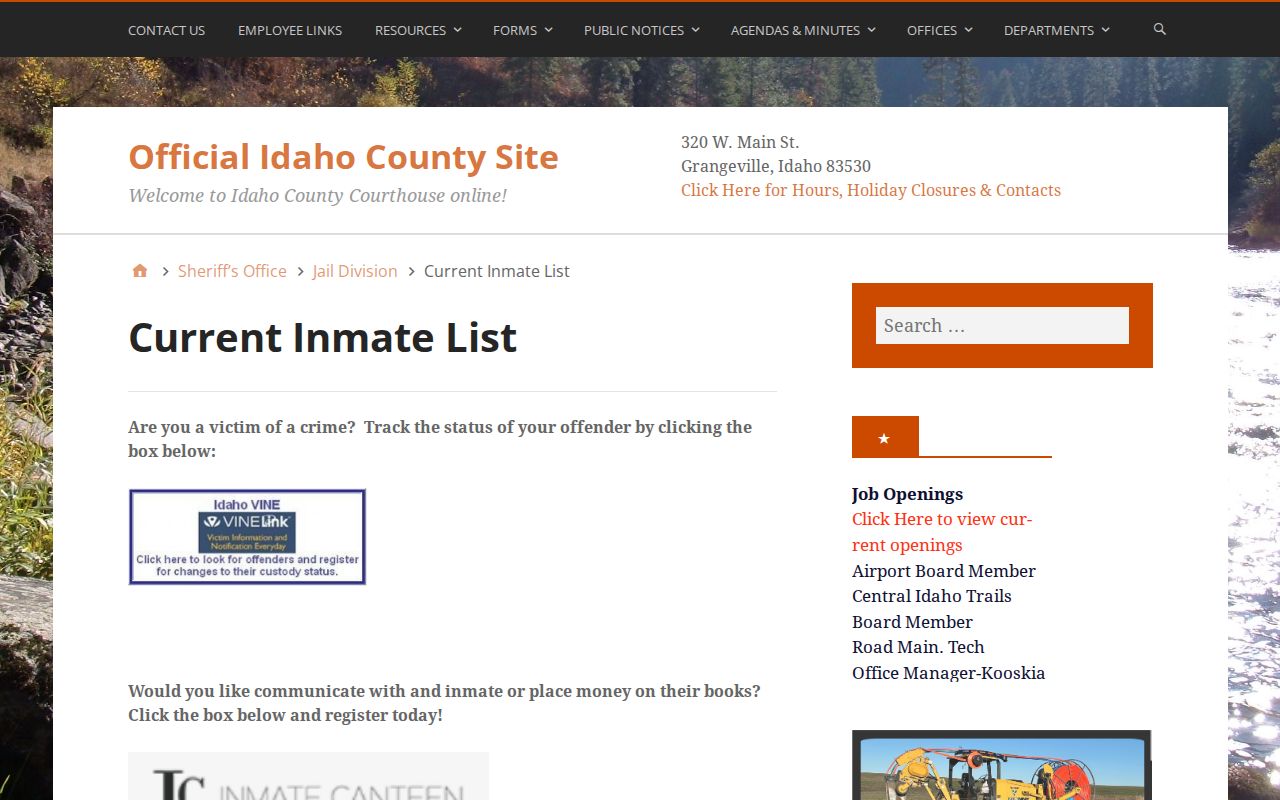
The official current list illustrates its limited current-custody fields.
Idaho County Supervision Records
Two supervision layers serve different judgments. IDOC District 2 handles felony probation and parole across five north-central counties. Idaho County Court Services handles adult misdemeanor probation and juvenile probation locally. The judgment, not a home address alone, identifies the right office. An IDOC result may name the supervising district, while the Idaho County court file identifies a local misdemeanor probation order.
Parole is a conditional IDOC release before sentence satisfaction. Probation is ordered by the court and may follow sentencing or retained jurisdiction. A person can have an old release date plus a later active bench warrant or absconder status. That later event does not erase the earlier community release, but it changes current status. The Parole / Probation page explains how to verify the correct supervision layer.
- Parole
- Conditional release from IDOC confinement under Commission authority.
- Probation
- Community supervision ordered by a court.
- Discharge
- Completion of the sentence or supervision shown by the owning agency.
- Detainer
- A request or legal basis for another authority to assume custody.
Correcting Idaho County Release Records
Record errors follow the record owner. Send a jail booking or release error to Sheriff Records. Send an IDOC status issue through the department’s Request for Information route. The clerk who owns the criminal case handles docket and document questions under court rules. A registry entry must be addressed to the sheriff listed as its verification agency. One office usually cannot revise another agency’s database.
IDOC release planning also encourages residents to work with a case manager on an Idaho credential and Social Security card. The Idaho DMV is the fallback for replacement credentials, and Idaho County’s driver-license office operates within the Sheriff’s civil services. Those identity records do not prove release, but accurate identifiers help agencies match the right person and reduce name-based errors.
Idaho County Courts Explain Release
The Idaho County magistrate division handles misdemeanors and preliminary felony matters, while District Court handles felonies. The iCourt Portal can show a register of actions with bond orders, dismissal, judgment, sentence, commitment, transport, probation, or satisfaction entries. The local clerk supplies documents that are not downloadable.
This split matters when a roster entry has vanished. A court order can explain the legal basis, while the jail record proves when staff completed the release or transfer. Neither should be stretched beyond its role. A bond order leaves the case pending. A commitment order can show that the next stop is IDOC. A dismissal resolves charges but does not prove the exact time the jail completed every hold check.
Idaho County Card Bond Releases
Idaho County Jail will not accept credit-card information. During business hours, the District Court Office may accept a card bond in person or by telephone. Confirm that the court accepted or authorized payment, then confirm that jail staff completed release processing. Other warrants, detainers, identification checks, or a receiving agency may affect the physical departure. Bond ends that jail custody event, but the criminal case remains pending unless the court later enters a final disposition.
Idaho County Jail Population Context
The Sheriff describes the jail built in 1954 as holding a maximum of 11 men and women, with an average daily population of 18 and average incarceration cost of $138 per day. The page gives no reporting period, so these figures should not be treated as a current trend or used to estimate annual releases. Crowding may help explain why transfers occur, but it never proves where one named person went.
Idaho County has pursued plans for a larger Sheriff and detention complex. Procurement goals are not an opening announcement. Until the county publishes authoritative notice that operations moved, the established Jail Division address and current facility map remain controlling.
Idaho County Jail Daily Charges
The Sheriff says the county bills $25 per calendar day under Idaho Code section 20-607. That obligation is commonly called pay-to-stay, but it is not a fee paid to obtain release. The bill may remain after physical custody ends. Keep it separate from bond, records-copy charges, and any court financial obligation so the existence of a balance is not misread as proof that release was delayed or denied.
Federal and Immigration Release Checks
The Federal Bureau of Prisons locator covers federal prison records from 1982 forward and may display a release date or “Not in BOP custody.” That phrase does not rule out county, state, immigration, or pretrial custody. ICE’s Online Detainee Locator is aimed at current or recent immigration custody, not a complete historical release file. U.S. Marshals custody questions often require the federal docket or the named holding facility.
Use these systems only when a case, detainer, or agency record points to them. Idaho VINE covers participating Idaho County Jail and IDOC events, but it does not cover BOP or ICE. A “transferred” alert means the next custody system must be checked. An official registry covers only people with a registration duty and does not establish a release date.
Idaho County Release Facilities
Idaho County Jail and North Idaho Correctional Institution are separate facilities with separate records. The county jail holds arrestees, pretrial detainees, and some short-sentence inmates. Its release or movement record comes from Sheriff Records and is read with the Idaho court file. NICI is an IDOC state prison in Cottonwood that runs the retained-jurisdiction program. A person leaving NICI may enter probation, transfer within IDOC, or return to the sentencing court.
- Idaho County Jail: confirm community release or transfer with jail records and the case docket.
- North Idaho Correctional Institution: confirm status with IDOC and the sentencing court.
Physical location in Idaho County does not make NICI cases county-jail cases. The sentencing county shown in IDOC identifies the court that owns the rider or sentence record.