
Idaho County Three-Day Release Window
No official 72-hour feed or selector was found in the Idaho County Sheriff’s jail pages or navigation. The one roster URL is the Current Inmate List. It answers who appears to be in county custody now. It cannot recreate Friday’s releases on Monday, and it states neither an update schedule nor a post-release retention period.
A three-day release inquiry therefore works best as a records request bounded by dates. Specify the first and last calendar dates, and say whether the result should include both people returned to the community and people transferred to another agency. This distinction matters. A county release timestamp can close the local booking while IDOC, another jail, or another authority continues custody.
Request Idaho County 72-Hour Records
Start with a defined interval rather than a broad request for all inmate files. If the period runs Friday through Monday, use those exact inclusive dates. The Records Division can identify what export or log is maintained and apply any lawful redactions. The request should also say whether transfers belong in the result, because a list limited to community releases answers a different question.
- Write the inclusive beginning and ending dates for the three-day interval.
- Ask for each release or custody transfer from Idaho County Jail during that span.
- Request the person’s name, booking number if available, timestamp, disposition, and receiving agency.
- Ask for electronic production and a cost estimate before chargeable work begins.
- Compare the response with iCourt when the legal reason for release or transfer matters.
- Use IDOC or VINE when the record points to another custody or notification system.
Submit through the Idaho County Sheriff Records Division. The Records Clerk can be reached at 208-983-1100 extension 2. Idaho County posts no fixed charge for a release-log request. The current county estimate controls because labor, redaction, and format affect cost.
Idaho County 72-Hour Fields
The Sheriff’s website does not display the release fields below. They are the focused items to request for the chosen interval. Each answers a different part of whether county custody ended and what followed.
| Requested field | Why it matters |
|---|---|
| Person name | Identifies the subject of the movement entry. |
| Booking number | Separates one jail stay from another. |
| Release timestamp | Places the event within the exact three-day window. |
| Release reason | Distinguishes bond, time served, court order, or other disposition. |
| Receiving agency | Shows when local release was actually a custody transfer. |
| Hold or detainer | Identifies another authority’s continuing claim. |
| Case number | Connects the event to the court register and order. |
A fuller booking record may also include arresting agency, booking date, bond method, and custody movements. Do not claim that every field exists in the jail software. Ask for the available record and separable portions. A narrow request is easier to process and reduces the chance that unrelated protected information controls the response.
Weekend Idaho County Release Checks
The wider window is most helpful when offices have been closed or when a same-day check was missed. Idaho County publishes no weekend or holiday release schedule, no routine release hours, and no public timing rule for removing a name from the roster. Do not assume a person was held until the next business day or released at a standard hour.
Court authorization, bond handling, records checks, detainers, and discharge work can happen at different points. For bond, the jail says it does not take credit-card information. During business hours the District Court Office can accept a card bond in person or by telephone. That payment does not itself prove the exact moment the jail completed release. The jail entry and docket should be read together.
If a weekend range matters for travel or reconnecting, call Idaho County Jail at 208-983-1123 for the recent status of a named person. For documentary proof, use the written log request. No researched source states a public waiting location, exit door, family pickup procedure, or transit arrangement, so those details must come from jail staff.
Idaho County Manual Roster Limits
The current roster includes a photo for some entries, a name, a short charge or custody phrase, and bond details. It has no booking date, release date, release reason, archive, or 72-hour filter. A name missing on the third day cannot show on which day the change occurred. It also cannot tell whether staff edited the page before or after the legal custody event.
The official interface is shown below. Its source is the Sheriff’s current inmate page.
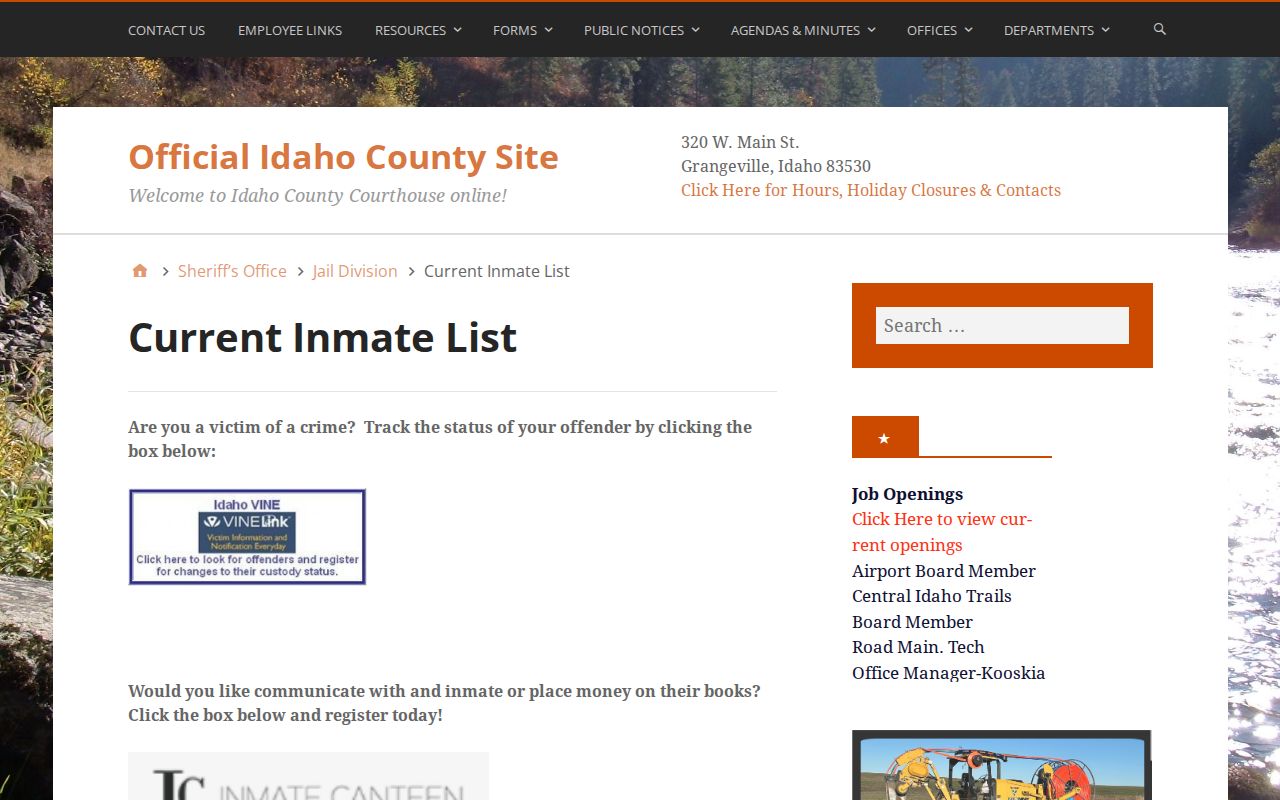
The screenshot documents a current-custody roster, not a gallery or historical feed of Idaho County releases.
Saving daily screenshots and subtracting names is unreliable. A disappeared entry does not distinguish bond, time served, data correction, transfer, a separate hold, or another outcome. The official movement log and court record provide that missing context.
Verify Idaho County Release Reasons
Use iCourt after the release log identifies the booking or case. A bond order may explain pretrial release. A dismissal or acquittal addresses case disposition. A judgment and commitment can explain an IDOC transfer. A probation order may explain a return to the community under supervision. The docket is stronger than roster disappearance, but the jail record still establishes the actual custody movement.
Search the Idaho iCourt Portal, narrow the result to Idaho County, and review the register of actions. Not every filed document is downloadable. Copies of case documents must be requested from the Idaho County Clerk under Idaho Court Administrative Rule 32. Court records and Sheriff records follow different access rules, so a single request does not reach both custodians.
- Bond release
- The person leaves pretrial custody while the case continues.
- Time served
- The local jail term ends, though another hold may remain.
- Transfer
- Custody moves to another agency without a community release.
- Probation
- The person lives in the community under court-ordered conditions.
Idaho County Transfer Follow-Up
When the log names IDOC, search the IDOC Resident/Client Search. Use an IDOC number when known, or search by last name and optional first name. Compare age, sentencing county, case number, status, and location. “In custody” points to continued state confinement. “In community” and “Released to Supervision” can show a later supervised release. “Discharged” indicates the state sentence or supervision shown has ended.
Idaho VINE is useful for alerts tied to one person. Read the event wording closely. “Transferred” means the reporting facility’s custody ended, not that all custody ended. VINE is not an archive for a three-day list, and it should be corroborated with the agency record. Federal BOP or ICE tools belong only in cases with evidence of a federal or immigration handoff.
Three-Day or Same-Day Records
The three-day method is for a defined span, especially after a weekend or delayed inquiry. The Released Last 24 Hours page is better when the question is limited to today and a rapid status check can be paired with a one-day log request. Neither page represents an online Sheriff feed because none exists.
For one known person, begin with the last agency rather than asking for every release. Match name variants, birth date if known, booking or case number, and the approximate stay. That targeted approach reduces false matches and directs the request to the office that owns the record.
Reconcile Idaho County Three-Day Results
A three-day response may combine several kinds of movement. Sort the entries by timestamp, then read the disposition and receiving-agency fields before counting community releases. One person may have more than one movement during the interval, and a transfer line can close the county stay without ending confinement. The booking number helps keep repeated names and separate stays apart.
Next compare each uncertain entry with the Idaho iCourt register. A commitment order can support an IDOC handoff, while a bond or probation order can explain release under continuing court authority. When the dates do not align, ask the Sheriff which timestamp reflects physical departure and which reflects data entry. Idaho County publishes no roster cadence, so the official log controls. Keep the exact inclusive dates in any follow-up request to avoid drifting into a different reporting period.
Public Record Search
Sponsored Results