
Idaho County 24-Hour Records
No official Idaho County Sheriff page answers who left the jail today. The available Current Inmate List is a present-custody page. It has no released tab, date selector, archive, or stated update schedule. A name that no longer appears is only a lead. It does not reveal a release time, release reason, or destination.
The same-day documentary route is the Idaho County Jail and Sheriff’s Records Division. A release record can establish when county custody ended and whether the person left on bond, completed a term, went to probation, or moved to another authority. The iCourt docket can then supply the order or disposition behind that event. A VINE event helps with prompt notice for one named person, but it is not the permanent record.
Check Idaho County Releases Today
Because there is no public feed, use a focused sequence. Begin with the last known custody system. Idaho County Jail handles local bookings, pretrial detention, and short county sentences. IDOC handles state prisoners and felony community supervision. The federal and immigration systems apply only when the case supports such a transfer.
- Check the Sheriff’s current list only to determine whether the name still appears.
- Call Idaho County Jail at 208-983-1123 for a recent status check.
- Ask the Sheriff’s Records Division for the release or movement log covering the stated calendar date.
- Search Idaho iCourt for the bond order, dismissal, judgment, commitment, or probation order.
- Check IDOC when the roster said “Sentenced to IDOC” or another fact points to state custody.
- Use Idaho VINE for a named person’s release or transfer notification and confirm the event with the reporting agency.
Ask for both the time and the disposition. “Disposition” means what happened to the custody event, such as bond release, time served, or transfer. A timestamp without the receiving agency can cause a transfer to look like a return home. For a broader name search rather than today’s full set, the Idaho County released inmate search explains the custody-specific paths.
Idaho County Release Fields
The online list supplies only current roster details. The fuller items below are fields to request from the Sheriff, not fields visible on the website. Narrow terms help the records clerk locate a usable export without guessing what the jail’s software calls each item.
| Field | What it establishes |
|---|---|
| Name and booking number | Connects the event to the correct jail stay. |
| Release date and time | Shows when Idaho County custody ended. |
| Release type or reason | Distinguishes bond, court order, time served, or another outcome. |
| Bond entry | Records the amount and method when bond applies. |
| Destination or receiving agency | Shows whether another jail, IDOC, or another authority took custody. |
| Hold or detainer | Identifies a separate legal basis that may continue confinement. |
| Related court case | Links the custody event to the controlling docket. |
The Sheriff’s current page may show a photo, name, brief charge or custody phrase, and bond information. It shows no booking date, release timestamp, released filter, or retention period. Its manually presented fields can vary. A before-and-after comparison of that page cannot replace the official movement record.
Request Idaho County Release Logs
The Sheriff’s Records Division routes written records requests. Identify the person by full name and name variants, approximate custody dates, date of birth if known, and booking or case number when available. Request the booking sheet, release entry, release date and time, reason, custody-movement log, bond entry, and receiving agency. Ask for an electronic copy and for exempt content to be redacted rather than the rest withheld.
For a same-day list rather than one person, specify the exact calendar date and ask for people released or transferred during that span. State whether the request should include both community releases and agency transfers. Idaho County posts no flat price for this release log, so request the current estimate. Idaho Code § 74-102 supplies the response framework, while § 74-103 permits examination and copying. Fees can depend on labor, copying, and redaction.
Pending matters, juvenile information, protected identities, and investigative or safety concerns can lead to lawful redaction. If an item is withheld, ask the custodian for the statutory basis. Court filings belong with the Idaho County Clerk under Idaho Court Administrative Rule 32, not in a Sheriff request.
Idaho County Roster Limits
The manual current-only roster deserves its own caution. It does not preserve departed entries for a stated span. It also gives no cadence, so the time at which a name is added or removed is unknown. A missing person might have posted bond, served a term, been moved to IDOC, gone to another jail, left under a court order, or disappeared because of an ordinary page update.
The screenshot below documents the interface that is actually available. View the source at the Idaho County Current Inmate List.
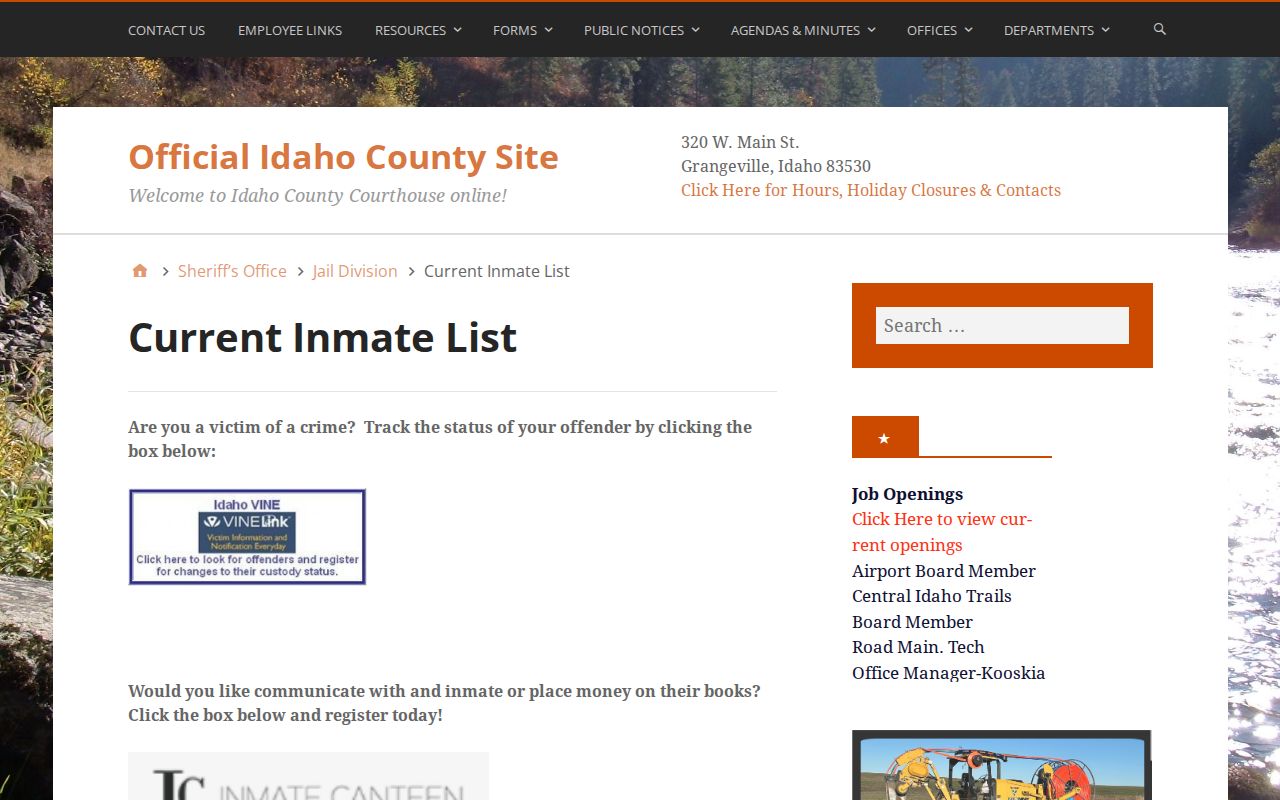
Its photo, name, short custody wording, and bond details help identify a current entry. They do not show who was released during a past 24-hour window.
Idaho County Bond Release Timing
Local bond handling adds a useful same-day distinction. Idaho County Jail says it will not accept credit-card information. During business hours, the District Court Office can accept a card bond in person or by telephone. Payment or court authorization is one part of the process; it does not prove the jail has finished identification checks, holds review, paperwork, and the physical discharge.
Confirm two facts separately. First, the court docket or bond record should show the legal basis for release. Second, the jail release entry should show when custody actually ended. Bond also leaves the criminal case pending. It is not a dismissal, acquittal, or final case result.
Idaho County IDOC Transfers
The phrase “Sentenced to IDOC” changes the next search. It means the announced destination is state custody. If that entry later disappears from the county list, do not label the person a same-day community release. Search the IDOC Resident/Client Search by IDOC number when possible, or by last name with an optional first name.
An IDOC result marked in custody confirms continued confinement. “In community” with “Released to Supervision” documents a later supervised release. “Discharged” points to completion of the state sentence or supervision shown by the agency. IDOC updates daily and warns that location and status can still change quickly, so the county movement record remains the best source for the exact handoff time.
Released or Still in Custody
A person still named on the county list remains in local custody as far as that page reports. A person absent from it needs confirmation. VINE may report “released” or “transferred,” and those events are not the same. The former ends the reporting custody; the latter directs the search to the receiving agency. iCourt explains the legal order but does not prove staff completed discharge at a particular minute.
- Release
- Custody by the reporting agency ends, sometimes with community supervision still in force.
- Transfer
- One agency closes its custody while another agency takes the person.
- Detainer
- A hold requesting custody for another authority.
- Recognizance
- Pretrial release based on a promise to return, without posting money bond.
For a longer interval that can catch delayed weekend checks, consult the Released Last 72 Hours process. It uses exact inclusive dates instead of trying to rebuild history from roster snapshots.
Match Idaho County Same-Day Records
A release entry becomes more useful when it is matched to the correct case and next custody system. Compare the full name, booking number, case number, and event date before drawing a conclusion. The iCourt register may show the court order that authorized bond, probation, dismissal, or commitment. It may not show when jail staff finished discharge, so keep the Sheriff timestamp as the custody fact.
If the movement entry names another agency, follow that agency instead of stopping at the closed county booking. IDOC records can distinguish state custody, community supervision, and discharge. VINE can add a prompt event notice, but its alert should be checked against the facility record. This matched approach prevents two common errors: attaching the event to a person with a similar name and calling a transfer a return to the community.
Public Record Search
Sponsored Results