
Idaho County VINELink Coverage
Idaho VINE, short for Victim Information and Notification Everyday, is the statewide custody-status and alert service. Idaho County Jail directly identifies itself as a participating jail. Current IDOC Victim Services material also describes phone, text, and email movement or status notices for people in state prisons.
That coverage crosses two systems but does not erase their difference. An Idaho County Jail alert comes from a county booking. An IDOC alert concerns state custody. A person can leave the county jail through a transfer to IDOC and still be confined. VINE does not cover the Federal Bureau of Prisons or ICE, so evidence of a federal or immigration handoff requires the matching federal locator.
| Field | What it can show | How to use it |
|---|---|---|
| Name and offender number | Identity supplied by the agency | Match both when possible |
| Custody status | Current reported state | Confirm with the reporting facility |
| Location and phone | Reporting or holding facility | Use for direct confirmation |
| Scheduled release date | A date when available | Treat as scheduled, not completed |
| Event label | Release or transfer | Do not treat the labels as interchangeable |
Search an Idaho County Inmate
A VINELink search is designed for one person. Use an exact name or an offender identification number. Common names can return more than one result, while spelling variations can hide the right record. Compare every available identifier and the facility before registering.
- Open VINELink and choose Idaho as the state.
- Enter the person’s name or offender identification number.
- Open the likely record and compare identifiers, custody status, location, and facility.
- Read whether the latest event says released or transferred.
- Call the facility listed in the record when immediate confirmation matters.
- For an Idaho County Jail event, call 208-983-1123; for a state event, confirm through IDOC.
A “released” result is the participating agency’s custody event. It is not a certified release sheet and does not decide the criminal case. A court docket may still show pending charges, probation, or another order. The full named-person fallback path is covered on the Idaho County released inmates page.
Register Idaho County Release Alerts
Registration is attached to the matching individual record. It is not a general list of everyone released. Choose the channels that can reach the registrant directly. A telephone number should not route through a switchboard because the automated system requires acknowledgment.
- Open the matching Idaho record or call 1-866-984-6343.
- Select notifications, then choose telephone, text, email, or several channels.
- Create a four-digit PIN for telephone calls.
- When a call arrives, listen to the event and enter the PIN followed by the pound sign.
- Update contact details after a number or email change.
- Follow any prompt to register again after a transfer.
Current IDOC instructions say an unacknowledged call may repeat every two hours for up to 48 hours. Operators can reset a forgotten PIN. More than one contact may be registered. These settings help delivery, but no automated notice should be the sole basis for an urgent response.
Note: Idaho VINE also provides a TTY line at 1-866-847-1298 for users who need that access channel.
Idaho County Release or Transfer
Idaho County specifically says VINE can notify when a person is released or transferred. The distinction is central. Release may mean the reporting facility ended custody. Transfer means another agency or facility may now hold the person. Even a county record with a release timestamp can represent a handoff rather than a return to the community.
If the Idaho County current list formerly said “Sentenced to IDOC,” search the IDOC Resident/Client Search after a transfer alert. An “In custody” state result confirms continued confinement. “In community” with “Released to Supervision” describes a later supervised release. If VINE lists another county jail, contact that receiving facility.
Federal and immigration transfers sit outside VINE coverage. Use the BOP locator only when the case supports federal custody and the ICE locator only when the record supports an immigration handoff. A miss in VINE does not disprove custody in those systems.
| Reported event | Next check |
|---|---|
| Idaho County release | Jail release record and iCourt |
| Transfer to IDOC | IDOC Resident/Client Search |
| IDOC release | IDOC status, supervision fields, and court case |
| Transfer to another jail | Receiving jail roster or records office |
| Federal or ICE handoff | Correct federal locator and case record |
Idaho County Victim Notification
The Idaho County Prosecutor’s Victim-Witness Unit provides a local legal-rights channel. After a complaint is filed, a qualifying listed victim receives a rights-notification form and may request information about sentence, incarceration, release, and escape. That process is separate from anonymous VINELink registration.
The two routes can coexist. VINE supplies automated agency events. The Victim-Witness Unit handles rights and case-linked notice. IDOC Victim Services separately provides certain notices about full-term release, escape, and death to registered victims at 208-605-4774. Each channel has its own eligibility, source, and scope.
A registry alert is different again. Idaho County links an OffenderWatch system for persons who have a legal registration duty. It is not a general inmate release service and should not be used as proof that someone was recently released.
Confirm Idaho County VINE Results
For a county event, call Idaho County Jail and request the booking, release, or movement entry from Sheriff Records when documentary proof is needed. Match the event to the iCourt register of actions. A bond order, dismissal, commitment, or probation order can explain the legal reason that custody changed.
For a state event, read the IDOC top-level status and each sentence row. “Released to Supervision” records the most recent placement on supervision, while “Sentence Satisfaction Date” is a different milestone. IDOC warns that its database updates daily but may not show the newest status or location.
VINE is most useful as a prompt to check the source. Preserve the event wording, note the reporting facility, and confirm before describing the person as back in the community.
When Idaho County Alerts Conflict
A VINE event and a live roster can appear to disagree for a short time. The roster may still show a person after a release order, or it may drop the name before a receiving agency posts a transfer. Neither screen substitutes for the event record. Note the time and exact wording, then call the facility that supplied the event.
If a transfer is suspected, follow the custody chain. Search IDOC when the county record points to a state commitment. Check another jail only when a receiving county is named. Use BOP or ICE only when the case supports that route. Searching every system without a custody clue can create false matches among people with similar names.
When the person cannot be found, verify spelling and any offender number before concluding the record is absent. A public service can have delayed feeds or an outage. The Idaho VINE telephone line provides another channel, while the jail, IDOC, and court remain the record owners.
For a legal explanation, use iCourt. A VINE release says custody changed; a bond order, dismissal, judgment, or probation order says why. Keeping those questions separate avoids turning a timely alert into an unsupported claim about the case outcome.
The official VINELink search screen begins with a state choice and person search.
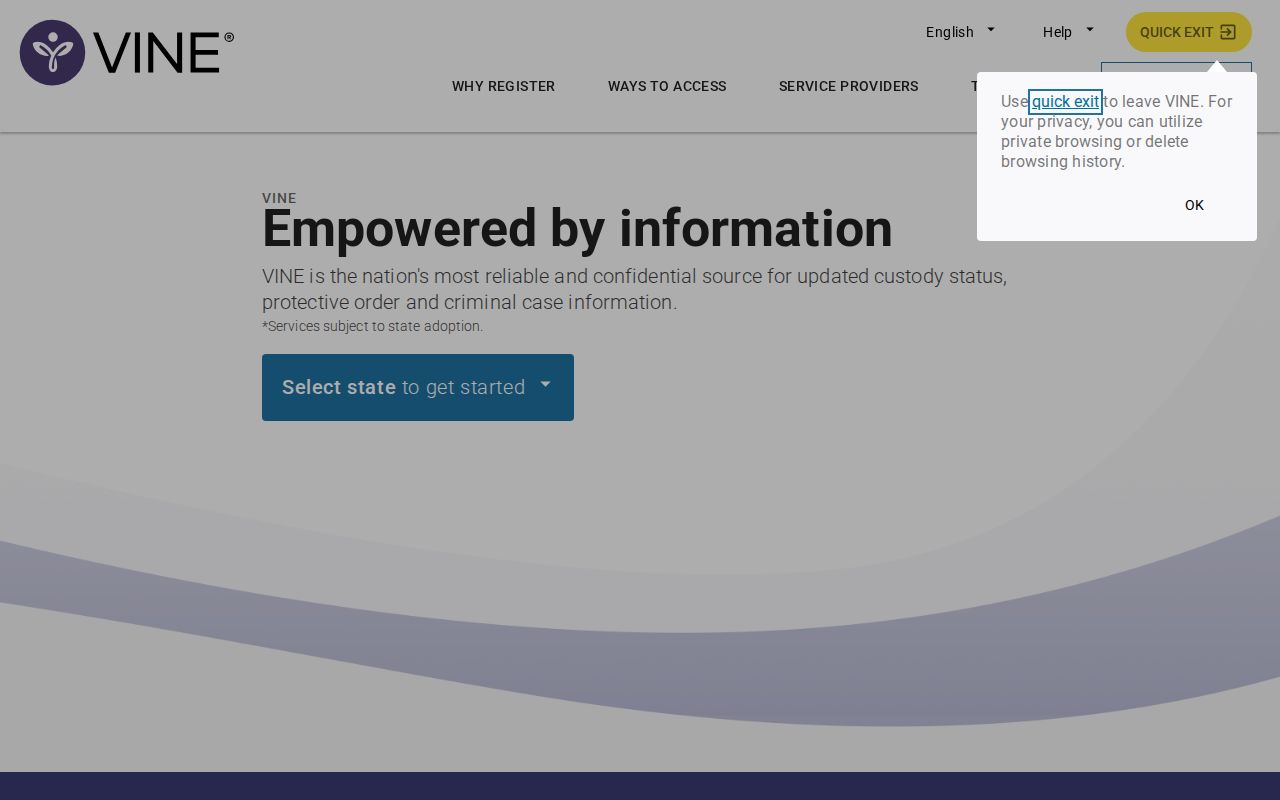
The screen documents the entry point, while the matching record and reporting agency provide the facts needed to interpret an alert.
Keep notification contacts current. A changed telephone number or email address can break delivery, and a transfer may require a fresh registration tied to the new record. Telephone registrants should remember that the PIN acknowledges the call; it does not unlock custody information. If an alert arrives without enough detail, use the facility phone shown in the record and provide the offender number. For a recent Idaho County event, Sheriff Records can supply the documentary movement or release entry. This extra check matters most when the event could represent a handoff, because the word “release” may describe the end of one agency's control while another authority immediately assumes custody.
Idaho County Alert Follow-Up
A release notice should be paired with the reporting agency's record. For Idaho County Jail, request the booking release or movement entry and compare it with iCourt. The release entry supplies the time and disposition. The docket can show whether bond, dismissal, sentence completion, probation, commitment, or another court order explains the change.
For IDOC, review the top status, current location or district, and every sentence row. Released to Supervision is a past event field. Sentence Satisfaction Date is the calculated end of a sentence row. Neither should be silently substituted for the other. If the detail is stale, IDOC Records Information is the correction and copy route.
Idaho VINE alerts can repeat until a telephone notice is acknowledged. Entering the four-digit PIN and pound sign confirms receipt, not the person's identity or case outcome. When several contacts are registered, each recipient should keep the offender number and facility name so a later event can be checked without relying on memory.
The Idaho County Prosecutor's Victim-Witness process remains distinct. A qualifying listed victim may request statutory case notices after a complaint is filed, while anonymous VINE registration follows the custody record. Using both channels can supply timely notice and case-linked information, but neither changes the need to verify an urgent event directly.
Public Record Search
Sponsored Results