
Idaho County Scheduled Versus Actual Release
A date shown before release is a forecast or legal milestone. It can establish eligibility, a hearing, the end of a sentence block, or the end of retained jurisdiction. None alone proves the person walked out of a facility. An actual event needs a jail release entry, IDOC “Released to Supervision” or “Discharged” status, or another completed custody record.
A pretrial detainee often has no set date. Bond may be available, but payment and a court order do not prove staff completed release processing. Holds can keep custody in place. A sentenced county inmate may have a calculated end date. A state prisoner’s IDOC record separates sentence and parole milestones.
- Parole Eligibility Date
- The earliest ordinary point when parole consideration can occur.
- Sentence Satisfaction Date
- The calculated full-term endpoint for a sentence row.
- Released to Supervision
- The last date the court or Commission placed the person on supervision.
- Retained Jurisdiction End Date
- A rider-program milestone followed by court action.
Find an Idaho County Release Date
Start with the agency holding the person. Idaho County Jail’s current list is only a live-custody page. It does not publish release dates or a release archive. The IDOC Resident/Client Search is the right public route for state prisoners and people under IDOC supervision.
- Check the custody source and identify whether the person is in the county jail or IDOC.
- For IDOC, search by number when possible, or by last name with optional first name.
- Match age, IDOC number, sentencing county, and case number.
- Read every date label in context, including eligibility, hearing, satisfaction, supervision, and retained-jurisdiction fields.
- For a county sentence, ask Idaho County Jail and the court for the sentence start, jail credit, good-time allowance, and release order.
- Confirm the completed event through the holding agency and court docket.
The broader records path is on the Idaho County released inmates search. A name missing from the county list is only a clue. The person may have bonded out, transferred, completed a term, or moved under another hold.
Idaho State Release Date Fields
IDOC does not label one field “projected release date.” Its detail record splits the sentence into milestones. Parole Eligibility Date is not a promise. Next Parole Hearing Date schedules consideration. A Commission Notice of Action Taken may set a tentative parole date, but programs and an approved parole plan must still be complete.
| IDOC or Commission field | Meaning | What it does not prove |
|---|---|---|
| Parole Eligibility Date | Earliest ordinary parole consideration point | Grant or physical release |
| Next Parole Hearing Date | Scheduled review date | Favorable decision |
| Tentative parole date | Conditional Commission date | Completed programs or approved plan |
| Sentence Satisfaction Date | Calculated full-term endpoint | That prison custody lasts to that day |
| Released to Supervision | Past placement on supervision | End of the sentence |
IDOC says the public database updates daily, yet location, status, and scheduled termination facts may change quickly. Request the authoritative calculation from IDOC Sentencing Records when the exact legal date matters.
The official IDOC search form shows the available name and IDOC-number fields.
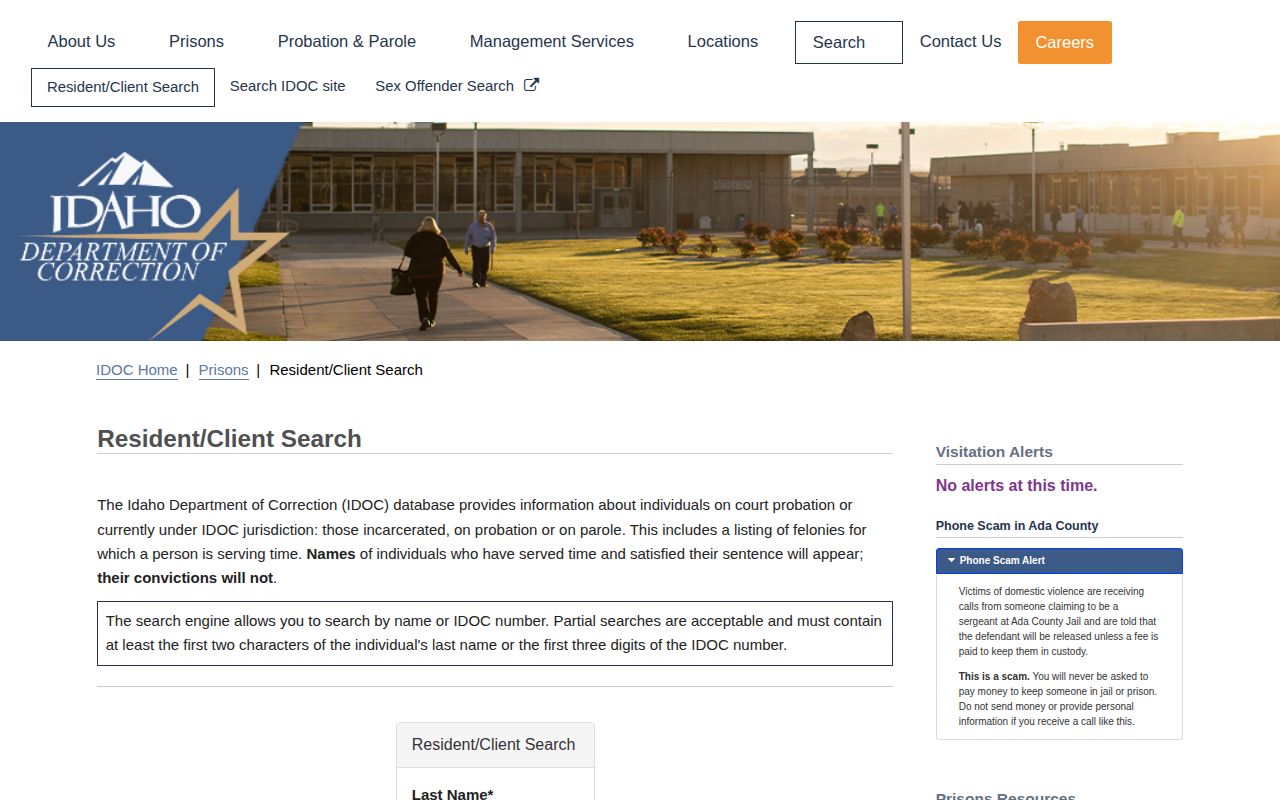
The form is the starting point; the detail record supplies the separate sentence and parole milestones.
Idaho County Fixed Sentence Rules
Idaho does not use a broad 85-percent rule. Under Idaho Code § 19-2513, the sentencing court states a fixed, determinate minimum and may add an indeterminate part. The person ordinarily serves 100 percent of the fixed minimum without parole, discharge, or routine good-conduct reduction. Parole consideration occurs during the indeterminate portion.
The narrow meritorious-service law in Idaho Code § 20-101D is not ordinary earned time. It concerns extraordinary conduct such as saving a life, preventing a major loss during a riot, or stopping an escape. Medical parole is also a narrow exception. Neither belongs in a routine online calculator.
Commission discretion operates under the current parole framework, including Idaho Code § 20-1005 and any case-specific mandatory rule. The judgment and sentence rows remain essential. Two people with similar headline terms may have different fixed portions, credits, consecutive cases, or parole outcomes.
Idaho County Jail Good Time
Idaho Code § 20-621 permits five days per month for a qualifying county-jail sentence when the person has a good record and performs assigned tasks in an orderly and peaceable way. The allowance depends on the Sheriff’s recommendation and the magistrate judge’s approval. It is not automatic.
Do not subtract five days from each calendar month and publish the answer. Ask Idaho County Jail and the court for the applied allowance, sentence start, jail credit, and order. Pretrial detention, another agency’s hold, or a sentence from a different authority may not fit the county calculation at all.
No official Idaho County weekend or holiday early-release policy was found. A date landing on a weekend should be confirmed with the jail rather than shifted by assumption.
Why Idaho County Dates Change
A projected date can move because a legal or custody fact changes. Some changes alter the sentence calculation. Others keep the sentence intact but delay or redirect physical departure.
| Factor | Possible effect | Confirm with |
|---|---|---|
| Amended judgment | Changes the controlling sentence | Sentencing court |
| Corrected jail credit | Moves the calculated endpoint | Court and sentencing records |
| Consecutive sentences | Extends the combined term | IDOC sentence rows |
| Parole decision | Grants, denies, defers, or rescinds a tentative path | Commission and IDOC |
| Program or plan approval | Can delay a tentative parole release | IDOC |
| Detainer or hold | Can transfer custody instead of returning the person home | Holding and receiving agencies |
| Retained-jurisdiction order | Can result in probation or continued imprisonment | Sentencing court |
Discipline, parole forfeiture, transfer, and Commission reconsideration can also matter. Read the current top-level status instead of relying on an old date copied from a prior result.
Confirm Idaho County Actual Release
For a county sentence, the Idaho County Jail release entry gives the executed time and disposition. The iCourt docket can show the order behind it. For state custody, “In community” with “Released to Supervision,” or “Discharged,” provides stronger evidence than a future date.
A release alert can help track timing. The VINELink Release Check explains registration and why a transfer alert is not the same as community release. Confirm a VINE event with the listed facility.
At North Idaho Correctional Institution, a Retained Jurisdiction End Date is not an exit record. Search the sentencing court after the rider period because the judge may order probation or continued execution of the prison sentence. The county shown in the sentence row owns that court case, even when NICI is physically in Idaho County.
The official IDOC detail example demonstrates Sentence Satisfaction Date, Parole Eligibility Date, and Next Parole Hearing Date as separate fields.
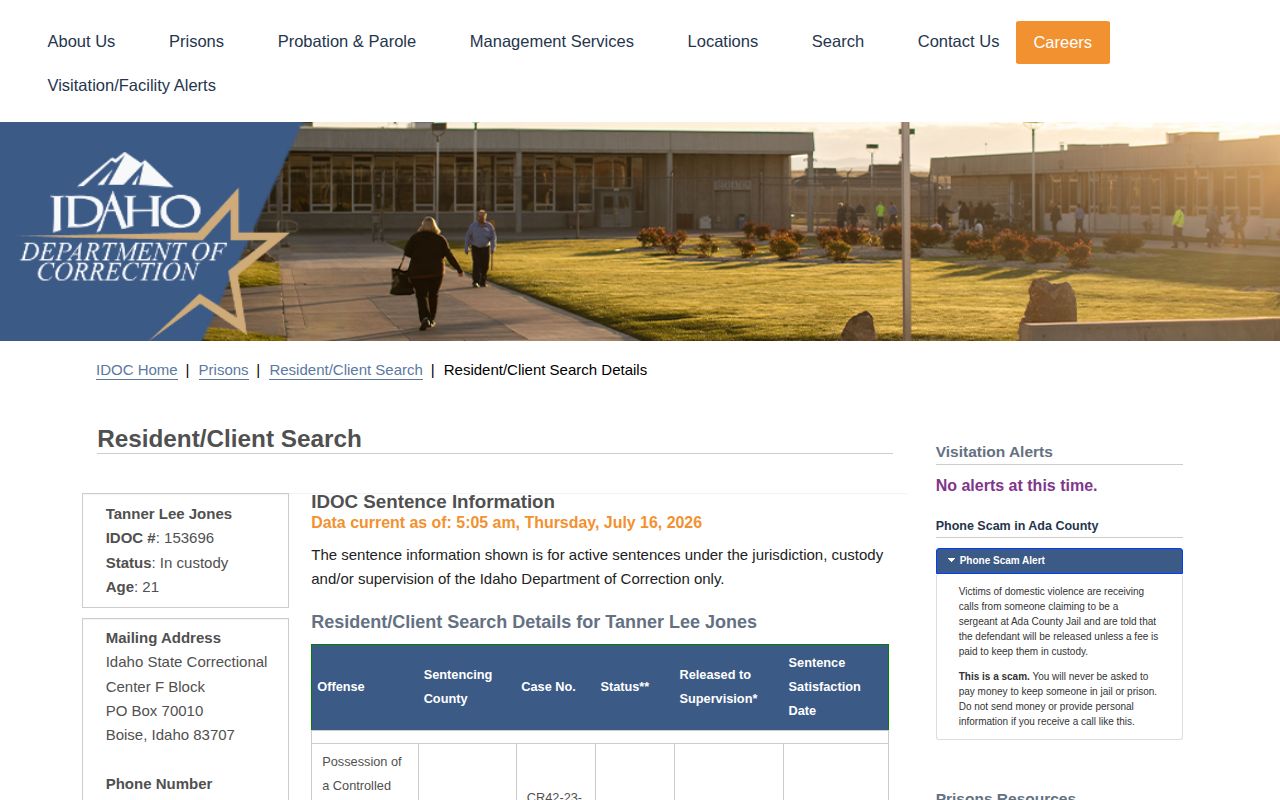
The example documents the interface only and does not identify an Idaho County release.
Idaho County Court Date Checks
The sentencing docket is essential when a public custody record does not explain a date. Search by party, narrow the result to the correct county and case, and inspect the register of actions. A judgment identifies the fixed and indeterminate terms. An amended judgment can change the calculation. A probation order can explain why a person moved from custody to community supervision.
Not every court document is downloadable. Court access is governed by Idaho Court Administrative Rule 32, and the clerk for the sentencing county handles requests for a specific order. NICI's physical location does not determine that clerk. Use the county and case number in the IDOC sentence row.
For an Idaho County case, the District Court office can route a request for the judgment, release order, or other accessible filing. Ask for the document rather than a broad case summary. The docket date may mark filing or entry, so read the order itself before equating that date with physical release.
A court can authorize release while jail staff still complete checks, or while another hold takes effect. Match the order with the jail or IDOC completed-event record. This paired check is more reliable than adding sentence lengths to an arrest date.
Idaho County Multiple Sentence Dates
One IDOC detail can contain several sentence rows. Compare each case number, sentencing county, status, and date instead of choosing the nearest or most distant value. Concurrent terms may overlap, while consecutive terms can extend the controlling calculation. The public page maps milestones but does not replace IDOC's official sentence computation.
A parole eligibility date can apply to one row while another term still affects custody. A sentence satisfaction date may show the full term even though lawful parole could move the person to supervision sooner. Ask IDOC Sentencing Records which date controls when the rows do not align.
County jail credit also requires the judgment and jail calculation. Time before sentencing may be credited by the court, but the amount should not be assumed from booking dates. Another agency's detainer can leave the sentence calculation unchanged while altering the destination. State the source and type of date whenever an Idaho County projected release is described.
A Commission hearing schedule is only a plan for review. The Commission generally posts later action notices, and those notices warn that a favorable date stays tentative. Program completion, an approved parole plan, and final IDOC processing stand between authorization and actual departure. Verify In community status after the stated date.
Retained jurisdiction adds a court step. A rider end date sends the question back to the sentencing judge, who may order probation or continued execution of the sentence. For someone at NICI, search the county named in the sentence row rather than assuming Idaho County owns the case because the prison is in Cottonwood.
For a county jail term, ask whether the five-day monthly allowance under Idaho Code § 20-621 was actually recommended and allowed. The statute does not create an automatic release calculator, and the research found no local weekend or holiday adjustment policy.
Public Record Search
Sponsored Results